For women on Ozempic, Wegovy, Mounjaro & Zepbound
It’s not “just the weight loss.” And no — you’re not imagining it.

The handfuls in the drain are real. The ponytail your hair tie now wraps around five times is real. And the follicles losing that hair? They’re not dying. They’ve been switched off.
There’s a moment you haven’t told anyone about.
Maybe it was the drain. The clump you had to pull out — big enough that you just stood there, holding it, water running down your back.
Maybe it was the brush. Full again. It was never full before.
Maybe it was the ponytail. The hair tie that used to go around twice now goes around four times. Five.
Or maybe it was a photo. You, smaller than you’ve been in twenty years, finally in the picture — and the only thing you could see was your part, wide and white under the light.
And then you did the math you didn’t want to do.
It started after the shot.
If that’s you — keep reading. Because before we talk about your hair, we have to talk about something the hair companies never bother to understand.
What this medication actually gave you.
First — remember what you won.
Nobody starts a GLP-1 on a whim.
You started after keto. After points. After the shakes, the fasting apps, the 1,200-calorie days that left you starving and still not losing. You lost the same twenty pounds so many times you could do it in your sleep — and your body put them back every single time, with interest.
And through all of it, the noise. The constant food math running in your head from the moment you woke up. Negotiating with yourself over every plate. Most people don’t live with that sound.
You didn’t know that until it stopped.
Because then came the shot. And within days — quiet. For the first time in your life, you ate like a normal person and thought about other things. And somewhere in that quiet, a truth landed that made you angry and free at the same time:
It was never willpower. It was biology. It was never your fault.
Then came the wins the scale never measured:
The seatbelt that clicked with room to spare. The restaurant booth you slid into without checking. The chair you sat in without testing it first. The dress. The pool. Crossing your legs.
And the photos. After years of standing in the back row, hiding behind your kids, angling behind someone’s shoulder —
you got in the picture.
You stopped hiding. That’s what you won. Hold onto that, because it’s exactly what’s at stake now.

You finally stopped hiding. Now your hair has you hiding again.
Somewhere around month two, three, four — it started.
On your pillow. On your shoulders. Across the bathroom floor. And in the shower, sliding out between your fingers in amounts that made you stop breathing.
Wash day used to be simple. Now you dread it the way you used to dread the scale. You put it off an extra day. You count what comes out. You feel sick before the water’s even warm.
And slowly, the old habits crept back — the ones you thought you’d escaped for good:
Skipping the photos. Sitting where the light isn’t. The messy bun and dry shampoo. A headband pulled low to cover your part on Zoom. Checking the top of your head in the car mirror before you walk in.
Do you see what’s happening?
You escaped a body that made you hide. And now your hair is building you another one.
Some nights you catch yourself doing math you swore you’d never do: would I rather be heavy with my hair… or thin like this? You’re not the only one — spend ten minutes in any GLP-1 forum tonight and count the women asking, out loud, whether they should quit the medication over their hair. Quit the drug that gave them their life back.
You should never have to answer that question.
“It’s just the weight loss,” they said. You knew better.
So you brought it up. And you got the line every woman gets:
“That’s not the medication. That’s just the rapid weight loss. It happens. Eat more protein.”
Maybe it came from your doctor — in the same tone that told you to “eat less and move more” for twenty years. Maybe it came from the group — women on the same shot, telling you you’re doing it wrong. Losing too fast. Your fault.
But you know your own timeline. Women shed on these medications after losing six pounds. Slow losers shed. Women doing everything right — the protein, the water, the vitamins — shed anyway, and kept getting told it was them.
Look at the shape of that.
For decades, they told you your body was your fault. Then science proved it wasn’t. Now your hair is coming out — and somehow that’s your fault too? You’re doing your own success wrong?
You’ve been dismissed about your own body twice in one lifetime.
That ends here.
So let’s say what nobody else will say: we believe you.
The shedding is real. The timing you noticed is real. And the research has finally caught up with what you’ve known all along:
- This happens to women more than twice as often as it happens to men. That’s not a theory off a forum thread — researchers went through the medical records of 16 million patients to find it (University of British Columbia, 2025).
- Lose more than 15% of your body weight, and the shed isn’t bad luck. It’s the odds — it happens to more than 4 out of 5 women. That’s 30 pounds if you started at 200. A 2026 clinical study of women on GLP-1s put the number on it (Alharbi & Alkhalifah).
- And it runs on a schedule — which is exactly how you know it isn’t random, and it isn’t you. It gets set off in your first few weeks on the shot, shows up in the shower two to four months later, and peaks right when your weight loss is at its steepest. Check that against your own calendar. It usually lines up to the month.
Every study on this page is named so you can look it up. That’s on purpose. You’ll see why.
You were never imagining anything. You were early.
And here’s what everyone arguing about “is it the drug or the weight loss” completely misses: while they fight about the trigger, nobody tells you what to actually do — because whichever side is right, the exact same thing happened inside your scalp.
Once you see it, everything changes.
or keep reading — the next few minutes explain exactly what happened inside your scalp ↓
Your follicles didn’t die. They got switched off.

Here’s the part nobody sat you down and explained.
Hair grows in cycles. At any moment, about 9 in 10 of your follicles are in the growth phase — building hair, day after day. The rest are in a resting phase: the follicle lets go of its hair, holds its place, and waits for the signal to start again.
Now — when your body senses a shock, it does something ancient. And losing weight fast while eating far less is exactly the kind of shock it evolved to notice. It goes into survival mode. Hair is expensive to grow, and to your body, hair is optional. So it flips thousands of follicles from GROW to PAUSE, all at once, to save resources.
Two to four months later, all those paused hairs release together.
That’s the handfuls. That’s why it came out in clumps instead of gradually. That’s why the timing lines up with your shot schedule. Doctors call it telogen effluvium — you’ve probably seen “TE” in the forums at 2 a.m.
Your body thinks it’s protecting you. It just hasn’t noticed the emergency is over.
And now the part that changes everything: paused is not dead.
Every one of those follicles is still there. Alive. Root intact, holding its place under your scalp, waiting for exactly one thing:
The order to start growing again.
Now, your body will send that order eventually — on its own schedule, many months from now, even years, once your weight settles and it finally notices the emergency is over. Your doctor calls that “give it time.” You’ve heard it.
But it leaves the question your doctor never got to. The one this whole page turns on:
What if you didn’t have to wait for the order — because you could send it yourself?
The protein, the biotin, the $80 vitamins — here’s why they were never going to be enough.
You did what they told you.
More protein. The ferritin blood test. Biotin. Collagen in the coffee. Maybe you even paid Nutrafol $88 a month to find out what everyone finds out.
None of it was wrong. It was just answering the wrong question.
Protein, iron, vitamins — that’s food. Supply. The groceries hair gets built from. Your instinct to fix that was right, and it matters for what’s coming.
But a paused follicle isn’t building anything.
It isn’t short on groceries. It’s waiting for instructions. You can feed a sleeping follicle perfectly, for months — and it will keep sleeping, with a full pantry.
Feeding a follicle doesn’t wake it up. Nothing you can swallow carries the wake-up order.
The order comes from somewhere else entirely.

Your follicles are waiting for a signal. Science has known its name for years.
Your body runs the entire hair cycle on chemical messengers called growth factors — tiny proteins that carry instructions from cell to cell.
When a follicle wakes up and starts growing, growth factors delivered the order:
- One reopens the blood supply around the root — a follicle can’t restart on a closed road.
- One carries the “grow” order itself and keeps the follicle in its growth phase.
- Others flip a resting follicle back into growth.
No signal, no restart. That’s the whole story of your shed in one line: a scalp full of living follicles that stopped receiving orders.
And this isn’t new. Doctors already use growth factors to regrow hair — you may have heard of it:
PRP. They draw your blood, spin it in a machine to concentrate your own growth factors, and inject them into your scalp with a needle. It runs $500–$1,500 a session, and it takes a series of them. Dermatologists charge that because it works — across nine clinical trials, PRP measurably regrew hair. And what’s in those injections doing the working? Growth factors. The signal.
So the real question was never “do growth factors restart follicles?” Medicine settled that.
The real question is the one that decides everything for you:
How do you get them — without needles, without $4,000, without a clinic?
Until recently there were exactly two answers: growth-factor serums from the clinical world — Calecim at around $360, Plated at $379 a bottle (google them, they’re real) — or nothing. Everything else on the shelf — every drugstore serum, every vitamin — is supply, not signal.
That gap is the reason Anara exists.
Meet Anara: the messengers behind those $1,500 injections — rebuilt as peptides, in a dropper you use at home.

Let’s be precise, because you deserve precise: PRP works by concentrating growth factors from your own blood. Anara uses working copies of those same messengers, built peptide by peptide to carry the same orders, and delivered where PRP delivers them: at the follicle.
Anara Peptide Hair Growth Serum is built on five of those peptides — including working copies of four human growth factors:
- The road-opener (VEGF). Reopens the small blood vessels around each follicle, so the root gets the flow a restart needs.
- The “grow” order (IGF-1). The messenger that tells a follicle to grow — and to keep growing instead of slipping back to rest.
- The restart pair (FGF-1 + FGF-2). The two signals that push a resting follicle back toward its growth phase.
- Plus a fifth conditioning peptide that keeps the scalp itself calm, balanced, and ready — because follicles wake up best in a healthy neighborhood.
A few drops along your part. One minute of massage. That’s the signal — delivered to the exact spot that’s been waiting for it since your first shot.
About our name. Science calls the growth phase anagen. It’s the phase your follicles got pulled out of — and the phase this serum exists to push them back into. That’s where “Anara” comes from. The name is the job.
And before we show you a single study — here’s what it looks like on real heads:

My Part Is Filling In
“It had gotten so wide I could feel the wind on my scalp. Four months in, it’s narrowed enough that I’ve stopped shifting it over to hide it — something I’d done every single morning for a year.”
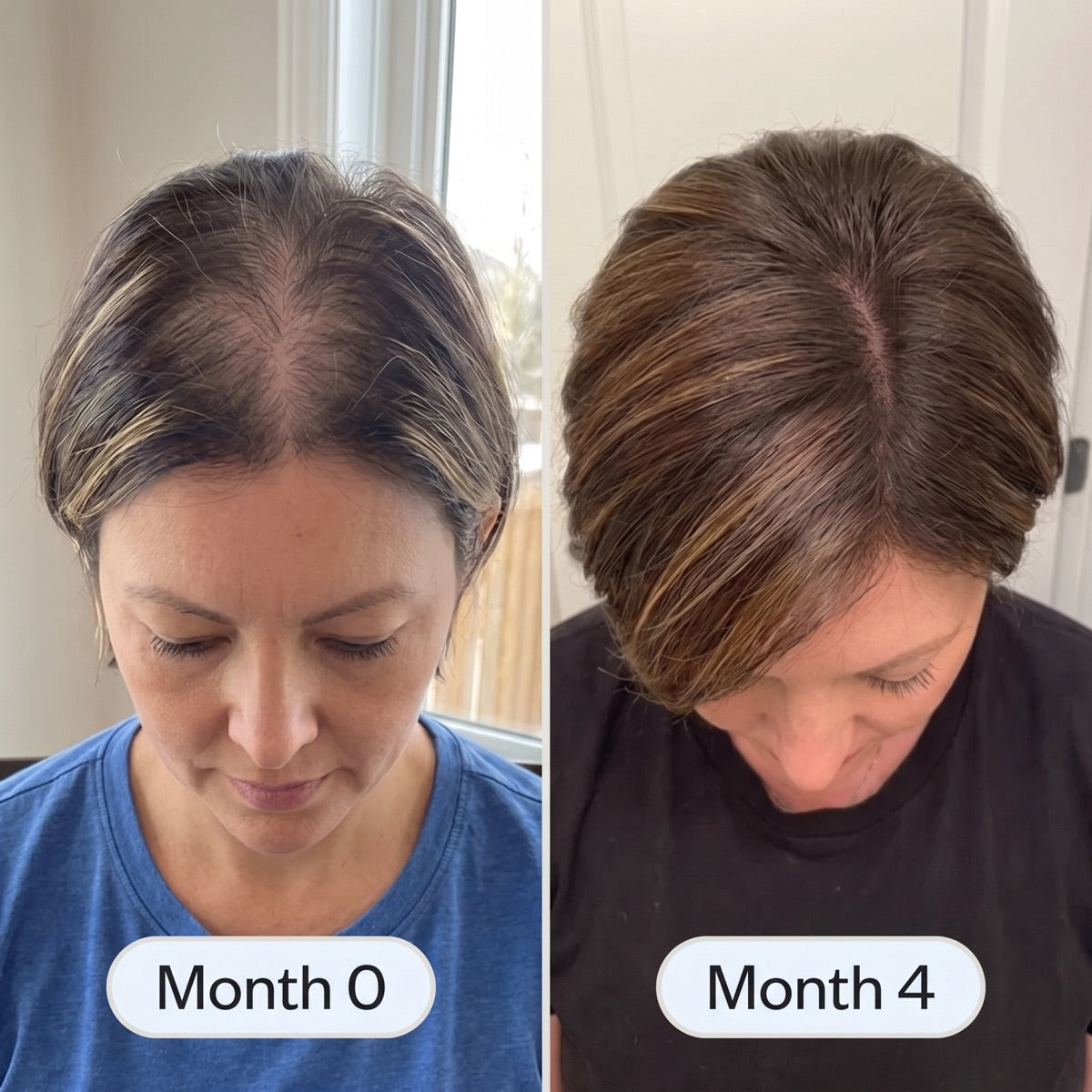
My Stylist Asked What I’d Changed
“She was the first to notice the loss back in January — ‘you’re losing a lot on the crown.’ Four months in, she stopped mid-blowdry: there’s new growth all over the top. She wrote the name down for two other clients on Zepbound.”
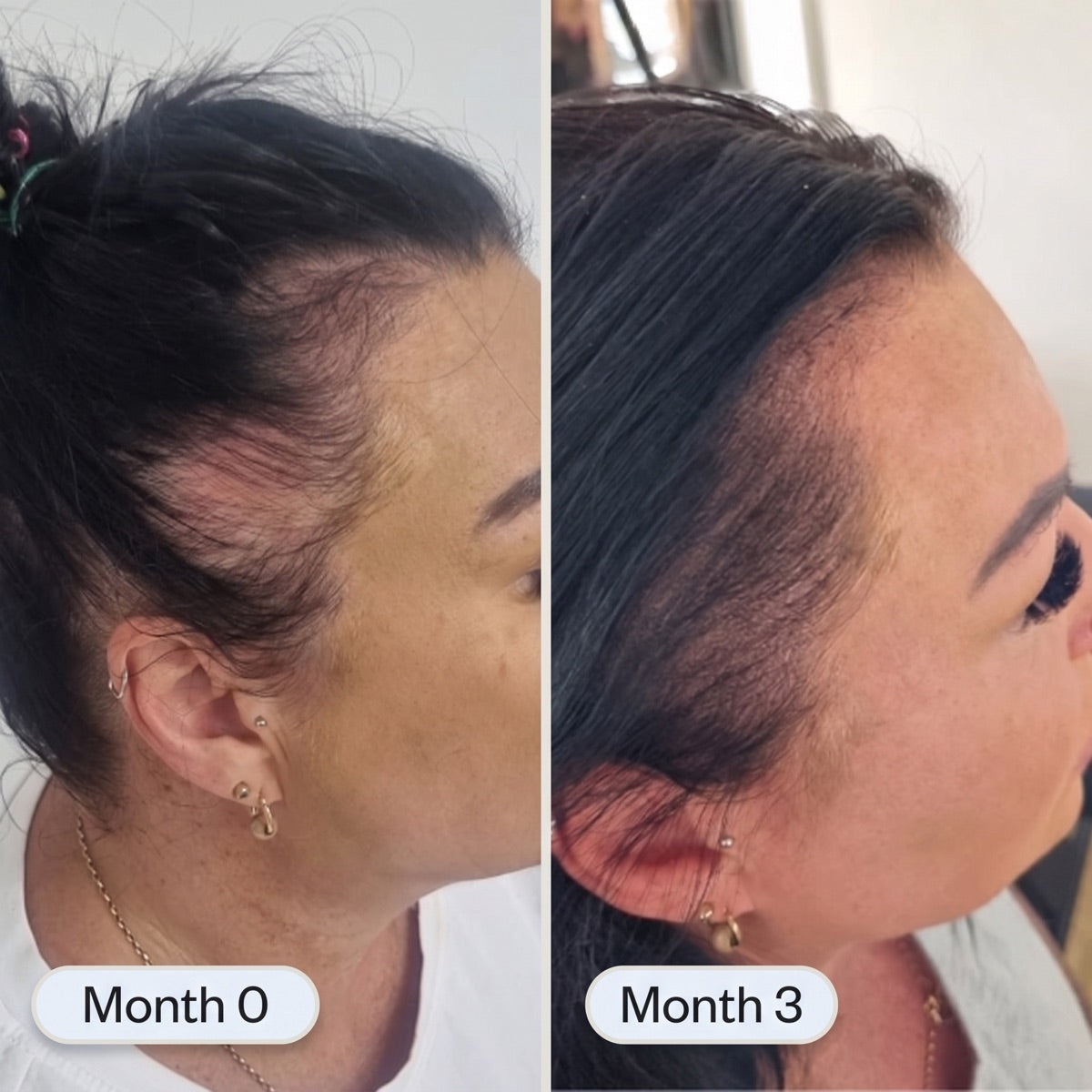
My Temples Came Back
“The postpartum shed, then the Zepbound shed right behind it — fourteen straight months of losing hair. Now my temples have completely filled in and the top isn’t see-through in sunlight anymore. I’d honestly started to accept this was just my hair now.”
or keep reading — next is the peptide in this bottle that went head-to-head with minoxidil, and won ↓
We put our money on a peptide that beat minoxidil.
You’ve been burned before, so let’s put the receipts on the table.
The head-to-head. In a study published in Experimental Dermatology (2016), researchers took the exact VEGF peptide in this bottle and tested it against minoxidil — the most famous name in hair regrowth, the yardstick for forty years — on living human hair-follicle cells. At a lower dose, the peptide outperformed minoxidil, producing more of the key signals follicles use to restart.
Sit with that for a second, because it’s rarer than it sounds. Most serums borrow their credibility — an ingredient “inspired by” something that tested well once, or a whole family of peptides where one distant cousin did something interesting in a study nobody links to. This is the ingredient itself, named on our label, put up against the biggest name in hair regrowth and coming out ahead at a smaller dose. It’s the only ingredient in any serum at this price with a published head-to-head against minoxidil at all. Not “inspired by” an ingredient that won. The ingredient. In this bottle. No drugstore serum and no $88 vitamin can put that on its label — and you don’t have to take our word for a syllable of it. The study is named above. Every ingredient is printed below.
And the peptides don’t work alone. Everything else in this bottle is there to do one specific job:
“But can a peptide even reach the root?” Fair question — on most skin, it couldn’t. Your scalp is different: it’s the most follicle-dense skin on your body, and every follicle is an open doorway straight down to the root. Anara wraps its peptides in lecithin — microscopic fat bubbles that carry them down the follicle. And that one-minute massage? It’s a pump: in lab measurements on human skin (European Journal of Pharmaceutics, 2014), massage multiplied how deep these carrier bubbles traveled into the follicle — as much as fivefold. And in a separate Japanese study, daily scalp massage alone measurably thickened hair in 24 weeks. The minute isn’t a ritual for the ritual’s sake. It’s part of the dose.
The bottle, the drop, the minute of massage — every piece is doing a job.
And the feel: water-light. Non-greasy — because thin hair looks thinner when it’s oily, so this never is. Fragrance-free. No minoxidil. No hormones. Nothing toxic to the dog or the cat. Made in the USA.
Go look any of this up. We know you will. We chose ingredients that survive women like you checking.

Dr. Christine Booth · Harvard-trained, board-certified dermatologist
Reviewed the formula and every mechanism claim on this page for accuracy.
And to make the checking easy, here’s something no hair brand puts this high on the page:
Here’s every ingredient. Screenshot it. Take it to your dermatologist.
You read labels. It’s how you caught the last three products that wasted your money. So instead of making you hunt for ours, here it is — the complete INCI list, nothing hidden, with the five peptides in bold and translated into plain English:
Google any line of it. Ask your derm about any line of it. Post it in your group and let the ingredient-readers go at it. This label was written to be checked — because the last five products you bought were counting on you not checking.
While you’re reading it, notice what’s not there: no biotin. No minoxidil. No hormones. No fragrance. No silicones to fake “thickness” for a day. Nothing on that list is there to impress you — it’s there to work.
One detail for the deepest label-readers (we know you’re here):
Where the peptides sit. On an INCI list, order roughly follows amount. Look at ours: the five peptides sit in the top half, ahead of the botanical extracts — not sprinkled at the bottom next to the preservatives the way “peptide” products love to do. The label tells you what the front of the bottle can’t fake.

or keep reading — next is the whole nightly routine, and it takes sixty seconds ↓
Sixty seconds a night. And wash day stops owning you.
Here’s the entire protocol:
- Part your hair where the thinning shows most. A few drops along the scalp.
- Massage one minute with your fingertips. (This is the pump that drives the peptides down the follicle — and the study-backed thickener in its own right.)
- Done. No rinse. No grease. Hair down, pillow safe, nobody knows.
But here’s what women tell us that one minute actually becomes:
For months, everything about your hair has happened to you. You watched the drain. You counted the brush. You waited and hoped and got told to be patient.
This is the first sixty seconds of the day where you’re not watching your hair.
You’re doing something about it.
Ask any hairdresser what they’re seeing in their chair right now.
Dana R. has cut hair for 22 years in Columbus, Ohio. She’s one of the first stylists we sent Anara to — we asked her to tell you what she’s seeing, in her own words, and we didn’t edit them.

“I know before they tell me. The part widens, the crown goes see-through under my lights, and the density between my fingers is just… less. I feel it before any doctor sees it.
A couple of years ago it changed. Now it’s the women on the weight-loss shots — some weeks I get three in one day. And they’re the hardest ones, honestly, because they’re glowing. Best shape of their lives. And then they look at me in the mirror and bring up their hair in this little voice, like it’s a confession.
First thing I tell every one of them: you’re not crazy, and you are not the only one — I see this every single week now. Second thing: it’s the sleeping kind of hair loss, not the gone kind. I’ve been behind a chair long enough to have watched a lot of comebacks.
And the comebacks all look the same now. The ones who stick with Anara’s Peptide Hair Growth Serum come back in my chair going ‘what do I do with all these baby hairs?’ — and I’m grinning, because that’s the best problem in this whole business.”
The drain empties out first. Then the baby hairs come in. Then the photos.
Pulled from our verified-review feed — every reviewer is a confirmed purchaser, in her own words.

Wash day had turned into something I genuinely dreaded — I'd end up sat on the shower floor peeling hair off my hands, crying, before I'd even conditioned. I'm nine weeks into this and last Sunday I washed my hair and barely anything came out. Thats the whole review. That is all I wanted.

After $88 a month on Nutrafol did absolutely nothing for me I swore I would never buy another hair product as long as I lived. The only reason I tried this one is that it isn't a supplement and there's no biotin in it — it's topical, it goes where the problem actually is. Three months in my brush isn't full every morning and I've got baby hairs the whole way along my part. I hate being wrong but I'll take it.

My son graduated in May and my entire plan for that day was to not be in a single picture. I'd started this back in January out of pure desperation. By the ceremony I had enough back that I stood in the front row of the family photo, and I've looked at it about fifty times since. I spent twenty years hiding in photos because of my weight — I was not doing it a second time over my hair.

My temples had receded so far back I was doing a deep side part and pinning it just to cover the gaps. I started this in December mostly out of desperation after a bad night. The temples have filled in almost completely, which is the exact area two different people told me never comes back. I'm wearing my hair straight back for the first time in two years.

Month three and I have a halo of fuzzy little hairs standing straight up off my part that will not lie down for anything. Nobody warns you that the good stage is the ugly one. I'm wearing it with a headband and a stupid grin. Six weeks ago I was looking at toppers online at 1am so I'll take goofy over see-through any day.

My daughter ordered this for me because she was tired of hearing me cry down the phone, and I told her flat out she'd wasted her money on it. I've been using it since April. There is a whole fringe of new hair across my forehead that was not there before and my ponytail is thicker in my hand. I apologised to her. In writing.
I spent forty years being told my weight was a willpower problem, finally found the thing that worked, lost 94 pounds — and then started losing my hair and got told that was my fault too. Losing too fast. Not enough protein. Doing it wrong. I was so tired of being blamed for my own body that I nearly gave the whole thing up. This was the first product that told me it wasn't just the weight loss and that my follicles were stalled, not dead, and seven months on I have my hair and my life and I did not have to choose.
It works, no argument from me — shedding slowed by week six and I've got regrowth along the part now at month four. I'm docking a star because one 30ml bottle only gets me about five weeks and I've got a lot of scalp to cover, so the real monthly cost is higher than the sticker suggests. Buy the multipack from the start and save yourself the reorder panic I had at week five.
I was two weeks away from telling my doctor I was done. 78 pounds down and I honestly thought I would rather be fat and have hair, that is how bad it got in month four. I found this, gave it a full 90 days, and I'm still on the med and my hair is coming back. Nobody should have to pick between the two and I'm so glad I didn't have to.
For the skeptics, here's an objective measurement: in February my hair tie went around five times. It now goes around three. Same tie, same ponytail, same me, four months of this serum. I don't need a clinical study, I have the elastic.
Nobody talks about the scalp pain. Mine ached constantly — that feeling when you take down a really tight ponytail, except all day, and sore to the touch on the crown. That was the very first thing to go, within about two weeks of starting this, and the shedding began slowing a few weeks behind it. I'd have paid for the scalp relief on its own honestly.
I'm 62 so I assumed this was simply what happens now — until I sat down and did the math and realised it started exactly three months after my first Ozempic shot, not one day before. Started the serum in October. My hairdresser measured the width of my part with her comb in February and again in June and it is genuinely narrower. Don't let anyone tell you it's just your age.
My edges went first, which anyone with my hair type will tell you is the worst possible place to lose it, and I'd already been through traction issues years ago so I was scared it was permanent. The dropper gets right down onto the scalp between my braids without soaking the hair itself, and there's no residue or build-up at all. Four months and my edges are filling in with real hair, not the fuzz that snaps off. It works on textured hair.
I have PCOS so my hair was already thin through the top before I ever started semaglutide, and when the shed hit at month three I completely panicked. The reason I chose this over the others is that it has saw palmetto in it alongside the peptides, which matters if you've got androgen thinning underneath the shed. Five months and my part is narrower than it was even before I started the med. I'm 31 and I'd been quietly grieving my hair since I was 24.
I'm on Zoom all day and the overhead lighting in my office was showing my scalp straight through the top of my head, so I'd started tilting my laptop down like an absolute lunatic in every meeting. Ten weeks in and there's a genuine layer of new hair up there catching the light instead of my skin. My camera stays on now and I don't think about it during calls.
I had three weddings in four months and I was a bridesmaid in one of them, and I was up at 2am googling toppers and comparing prices. I started this in January. By the June wedding I had enough back that I wore it down and didn't think about my hair once the entire day. That's the review — I didn't think about it once.
I had been spraying root powder on my scalp every single morning for eight months and by lunchtime it always went shiny and grey and looked worse than the bald bits. I'm on bottle three of this and I haven't touched the Toppik in about five weeks — my part just fills in on its own now. I threw the can in the bin last night and it felt like a ceremony.
I was hitting 130g of protein a day, my ferritin was 82, my vitamin D was fine, and I was STILL losing it in handfuls, which made me feel like I was going insane. The thing that finally clicked was reading that food feeds a follicle but it doesn't tell a sleeping one to wake up — those are two different jobs. I'd been doing one of them for eight months. Five months on this and the other half is finally handled.
I lost ELEVEN pounds. Eleven. And I was losing hair by the fistful, and every time I posted about it somebody would tell me it's the rapid weight loss. It was not rapid and I was not imagining it. This is the first thing anybody has offered me that treated the problem as real, and three months on the shedding has stopped and there's regrowth at my crown.
It was on my clothes, in the car, all over the sofa, in my dinner. My husband kept finding it in the kitchen and saying nothing, which was somehow worse. It sounds trivial next to the panic part but it was an hourly reminder of what was happening to me. Ten weeks of this and it has basically stopped, and having the house clean of it is its own kind of peace.
Six months, honestly reported: less in the drain at week five, baby hairs at three months, and now real thickness I can feel when I put my hand in it. I'm 47, I'm down 68 pounds, and last week I caught my reflection in a shop window and thought I looked good — which I have not thought in a very long time. I'm starting to feel pretty again and I'd forgotten that was even available to me.
I quit Mounjaro last year specifically over my hair, gained 40 pounds of it straight back, and spent the whole time hating myself for it. This time I started the serum the same day I restarted the med. Six months in, 46 pounds down, and my hair is honestly thicker than it was at the start. If I'd had this the first time round I wouldn't have lost a year of my life.
My doctor's entire treatment plan was more protein and give it six months, and I'm sorry but six months of watching it come out is not a plan when you're 54 and already thin on top. This gave me something to actually DO every night instead of standing there counting what was in the drain. Four months later the shedding stopped and there's regrowth at both temples. Doing something beat waiting.
Female, on compounded tirzepatide, down 21% of my starting weight — turns out that's about the highest-risk combination going, and I found that out the hard way in month four. I started this the same week the shed hit. It slowed noticeably by around week seven and I've had steady regrowth since. If you tick those boxes, start it before you need it — that's my whole advice.
I'm on the jab, I'd only lost two stone and slowly at that, taking all my protein and my vitamins, and I still got told on every single forum that it was just rapid weight loss. It wasn't, and I'm so relieved somebody finally said so out loud. Sixteen weeks in and the hairfall has calmed right down with new bits coming through at the front. Worth every penny of it.
I sat on a minoxidil prescription for two months because I could not face a dread shed on top of what was already happening — the thought of it getting worse first made me physically ill. There is no initial shedding phase with this, so I just started, that same night. Twelve weeks later there's less in the drain and little spikies along my hairline, and I never had to go through a worse phase to get here.
I have two cats who sleep on my head every night, so Rogaine was never an option for me and my dermatologist basically just shrugged at that. This has no minoxidil in it at all, which is the entire reason I was able to start anything. Four months into the tirzepatide shedding and it has slowed right down, and the cats are fine. Relief on both counts.
Every serum and oil I tried sat on my head like a slick and made the thinning look ten times worse — flat, greasy, and you could see straight down to my scalp through the middle. This one is water-thin, I put it on a towel-dried scalp at night and by morning there is nothing there. Two months and my roots have actual lift again. Fine-haired girls, this is the one.
I started this the same week I did my first 2.5 of Mounjaro because everyone in my group was posting shower-floor pictures and I was genuinely terrified. Seven months and 52 pounds later I've shed maybe normal amounts — nothing remotely like the handfuls people described to me. My only regret is that I nearly talked myself out of buying it because it hadn't happened to me yet.
Buy the three pack. One bottle lasted me about six weeks and hair does not do anything meaningful in six weeks — I'd have quit at exactly the point it was starting to work and blamed the product. Month one was less shedding, month three was baby hairs, month five is actual thickness in my hand. The three-month version is the only honest way to use this.
I started Zepbound in March and read the sub for about three days before I ordered this — every single recovery post said "I wish I'd started sooner" and I took the hint. I'm six months and 41 pounds in with a bit of extra shedding but nothing like what my friend on the same dose went through. Next to what I'm paying out of pocket for the med every month, this is cheap insurance.
Perimenopause and a GLP-1 together is a brutal combination and my hair was taking it from both directions at once. I've used this since January, every night, no days off. The shedding stopped around week nine and the regrowth turned up around week fourteen. It's the only thing that's actually shifted in two years of trying things.
My daughter is the one who spotted it — she was stood behind me at the bathroom sink and said "Mom, you've got all this new hair." I hadn't told her I was using anything. I'm 55, down 60 pounds on semaglutide, and I had quietly made my peace with being thin on top for the rest of my life. Apparently I didn't have to.
I cut 14 inches off in a total panic because the ends had gone so stringy and thin, and then I cried about that too. Started this the week after. Six months later my hair is dense enough that the short cut actually looks intentional, and there's a whole new layer underneath. I'm growing it back out, which I genuinely never thought I'd get to say.
I'm an RN and I went into this fully expecting marketing nonsense, because 95% of this category is exactly that. What got me was that the evidence is actually tiered honestly — they tell you which findings are in vitro and which are human trial data, and nobody in this industry does that. Then it worked, which was the surprising part. Four months, noticeably denser, still on my tirzepatide.
I read INCI lists for fun so I researched this whole thing before I spent a cent — sh-Polypeptide-9 is recombinant VEGF-A, and there's a 2016 paper where it went head to head against minoxidil in human dermal papilla cells and did better at a lower dose. That is more than any of the peptide serums at Sephora can say for themselves. So I bought it, and fourteen weeks later my density is visibly better in the same bathroom lighting I'd been documenting the damage in.
I used The Ordinary's density serum for five months and it was fine — nothing bad, but nothing much either. This is a different category; those are biomimetic peptides and this has actual recombinant growth factors, the class they use in the $300+ clinic serums. I could tell the difference by week eight and I can see it in the mirror now. Same routine, completely different result.
I do hair for a living and I am seeing this constantly in my chair now — women on these meds, shedding through the crown, and nothing on the back bar touches it. I started using it myself when it happened to me at month four on Zepbound. It's the first thing I've ever been able to recommend to a client honestly. I keep a bottle at my station now.
I was already on topical minoxidil and I wasn't willing to give it up, so I asked before I ordered and was told it layers fine. I do this one at night and the minox in the morning — no irritation, no pilling, no weird interaction. Honestly since I added this the shedding dropped off faster than minox alone ever managed in a year. Four months and both are staying.
The shed made me feel completely helpless, like I was just stood there watching it happen to me and there was nothing to do but count. Five minutes at night, part it into sections, massage it in — it's the one part of this whole thing that's mine. And it's actually working, which helps, but I'll be honest the ritual alone got me through the worst month of it.
My weight stabilised around month eleven and the shedding did slow down by itself, exactly like everyone promised — but nothing was actually growing back. I was just stuck at thin. I added this at that point and within about ten weeks the regrowth finally turned up. It felt like it gave my follicles the shove they clearly weren't giving themselves.
Practical review for once: the dropper doesn't leak, the bottle survived three flights in my toiletry bag, and there's no fragrance so I could use it at my mother's house without her asking what it was. It's water-based so I put it on at night and my pillowcase stays clean. And after four months my hair is visibly thicker, which is obviously the actual point.
There is a whole undercoat coming in underneath the length that never fell out and it's finally long enough to see in the mirror. It doesn't fit in the ponytail yet, it sticks out at the sides, and I love it. My hair feels dense at the root again for the first time since I started Wegovy fourteen months ago.
Ten weeks in and being completely honest: the shedding has definitely slowed, but I'm only just seeing the tiny new hairs and I'd hoped for more by now. They do tell you 3-6 months up front so this is my expectations, not the product's fault. Four stars for now and I'll come back and update — I'm not quitting, I just wish someone had warned me that week eight is the discouraging one.
My part had gotten so wide I could feel the wind on my scalp, which is the detail I could never explain to anyone without them telling me I was being dramatic. I started this in February and in the last few weeks it has narrowed enough that I've stopped shifting my part over to the side to hide it. That is not a small thing when you've been doing it every single morning for a year.
My stylist was the first person to say anything back in January — "wow, you are losing a lot on the crown" — and I sat in that chair and just went numb. I saw her last week, five months into using this, and she stopped mid-blowdry and asked what I'd changed because there's new growth all over the top. She wrote the name down for two other clients of hers on Zepbound. Best validation I could have asked for.
I had the postpartum shed and then the Zepbound shed right behind it, so I lost hair for fourteen straight months and my hairdresser actually asked if I was okay. I started this at eleven months postpartum. My temples have completely filled in and the top isn't see-through in sunlight anymore. I'm 33 and I had genuinely started to accept that this was just my hair now.
I went from wrapping my hair tie twice to five times around what was left of my ponytail, and that's when I stopped sleeping properly. Started this at the end of month five on Zepbound and the first thing I noticed was the drain — by week six there was no little animal down there anymore. I'm four months in and I'm back to three wraps, with a whole layer of shorter hair underneath that isn't long enough to make it into the tie yet. I cried, but the good kind this time.
or keep reading — next is what wash day looks like once the shed is behind you ↓
Picture wash day, six months from today.
Water’s running. You work the shampoo through and your fingers come back — empty. You realize, mid-rinse, that you weren’t counting. You’d forgotten to be afraid of the drain.
Along your part there’s a fuzzy halo of short new hairs that stick straight up and refuse to be styled — the awkward, wonderful phase nobody warns you about, the one every recovered woman grins about, because baby hairs are the flag your follicles fly when they’re back.
Your hair tie goes around three times and holds.
Your stylist stops mid-part: “Okay — what have you been doing?”
And when the phone comes out at Thanksgiving, you don’t drift to the back row, and you don’t reach for a headband, and you don’t tilt your head down. You stand in the middle, next to the people you love, with the body you fought twenty years for and the hair you were born with — and you look at that photo, and for the first time in a long time,
you love the whole person in it.
That’s not a fantasy. That’s just the hair cycle, restarted, doing what it’s done your whole life.
Tonight, your follicles are still waiting. And the clock is honest.
Right now, none of that has happened yet.
Tonight the brush is still filling. Wash day is still circled in your head like a dentist appointment. The headband is still on its hook, doing a job it was never supposed to have.
And here’s the honest math about the clock:
Hair grows about half an inch a month — and only after a follicle wakes up.
A follicle that gets its signal in the next few weeks has grown three visible inches by the six-month mark. A follicle still paused three months from now is three months behind — length and fullness you simply won’t have at the graduation, the wedding, the beach.
The shed already took months you can’t get back. Every week of waiting hands it another one.
You already know what waiting gets you. You gave it twenty years once — and the best decision of your life was the day you stopped.
You know how to do this part. You’ve done it before.

or keep reading — next are the hard questions you’d ask before buying, every one answered ↓
You’ve been burned before. Ask the hard questions — here’s every answer.
“How is this different from Nutrafol and the vitamins I already wasted money on?”
Different category entirely. Those are supplements — supply-side, swallowed, hoping some fraction finds your scalp. Anara is not a supplement. There’s no biotin in it, nothing to swallow, no $88-a-month auto-ship. It’s growth factor peptides — the signal — applied directly on the follicles that need it. The stuff in your cabinet feeds hair. This is what tells hair to grow.
“Why not just get minoxidil?”
Minoxidil is real — we’d never tell you otherwise. But ask the women using it. First, the “dread shed”: minoxidil famously makes you shed more for weeks before it helps. You’re already losing handfuls — the last thing you can face is losing faster on purpose. Anara has no shed phase. Second, it’s forever: stop minoxidil and you lose what it gave you — a lifetime lease, and you already have one lifetime medication. Third: it’s toxic to cats and dogs. Fourth: the grease, the broken sprayers, the prescription for the oral kind. And underneath all of it: minoxidil was built for a different condition — pattern baldness. Your follicles aren’t miniaturizing. They’re paused. Growth factors are the signal matched to your condition. Start today, shed nothing, keep what you grow.
“The Ordinary’s peptide serum is $24. Why is this $69?”
Because “peptide” isn’t one thing. The Ordinary uses cosmetic peptide blends — good ones. It does not contain growth factors. Nobody’s does at that price: the only other serums built on growth factors are clinical brands like Calecim (~$360) and Plated ($379 a bottle). Anara puts the clinical-tier ingredient class at a price a normal woman can actually run for a full protocol. On the 3-month protocol it’s about $1.75 a day — while the shot itself runs most women $8 to $18 a day. You’re already paying real money to keep the body you fought for. This is the smallest line item in that fight, and it’s the one guarding your hair.
“Okay, reverse question: if growth factors are the $360 ingredient, how are you only $53 a bottle? What’s the catch?”
Fair — you should ask it. Three unexciting reasons, no catch: One, lab-made peptides used to cost a fortune to produce; the synthesis got dramatically cheaper over the last decade, and the clinical brands kept clinical prices anyway — their buyers come through dermatologists and medspas, and the price is part of the branding. Two, we sell one product, directly to you, from this page — no clinics taking a cut, no retail margin, no celebrity on the payroll. Three, we’d rather run at a normal margin and have you finish the protocol than price like a med-spa and have you ration drops. The $360 serums aren’t lying about their ingredients. They’re just charging you for their distribution.
“Is it safe with my medication?”
Nothing to swallow, nothing systemic — it works where you put it, on your scalp. It doesn’t touch your Ozempic, Wegovy, Mounjaro or Zepbound, your dose, or your progress. (It even layers fine with minoxidil if you’re already on it.) Keep your shot. Keep your loss. That’s the entire point.
“I’m still losing weight — my ‘trigger’ isn’t over. Does it even make sense to start now?”
This is the best question on the page, so here’s the straight answer: yes — now is exactly when it matters most. While the weight is still coming off, your body is pushing follicles into pause at the fastest rate it ever will. That’s precisely the window to have restart signals arriving every night — you’re waking follicles at one end while the medication pauses them at the other, instead of letting the pause pile up unopposed and starting from the bottom later. Women who start mid-loss protect the hair they have while they lose. And the biggest visible payoff arrives right as your weight starts to level — because your follicles spent those months getting signaled instead of sitting silent. If the shed is water coming into a boat, starting now is switching the pumps on — and pumps matter most while the water’s still coming in, not after.
“Will I have to use it forever?”
No — and this matters. Your shed is a temporary condition, so this is a protocol, not a life sentence: most women run it 3–6 months, through the shed and into regrowth. And unlike minoxidil, walking away doesn’t undo your regrowth — the hair that grows back is yours. It always was.
“My hair was already thinning a little before the shot. Will this still work?”
This is more common than you think — a big shed often unmasks thinning that was creeping in quietly. It’s why we included saw palmetto, which guards exactly the follicles that kind of thinning targets, alongside the growth factors doing the restart. You’re covered on both fronts.
“I’m 51. Honestly — how much of this is the shot, and how much is just my age?”
The question under the question, and you deserve a straight answer: often it’s both, and that’s exactly why the shed hit so hard. Around perimenopause and menopause, many women’s hair was already quietly thinning — then the medication’s shed lands on top and pulls the curtain off it all at once. Here’s what matters: the growth factor peptides work on the paused-follicle problem — the shed — no matter what your age is, because the restart signal is the restart signal. And the saw palmetto is in the bottle precisely for the age-related kind, the slow-thinning follicles the shed exposed. So you’re not choosing which problem to treat. The dropper doesn’t care which one caused which hair — it signals all of them. The women in our reviews are mostly 40 to 60. Read them with that in mind.
“Won’t it grow back on its own if I just wait?”
Notice that nobody who says that will tell you when — or promise you it does. Your body won’t lift the pause while the weight is still coming off, so the women who wait talk in years, not months: a year of drains, eighteen months of hiding your part, and no promise at the end that all of it came back.
Your follicles are waiting on an order your body isn’t sending. Growth factor peptides carry that order themselves, from the very first night. Less in the drain by weeks four to eight. Baby hairs by month three. Your ponytail thicker by month six.
One of these has a schedule. The other has “eventually.”
“Wait — if it comes back on its own eventually, how will I ever know it was YOU and not just time?”
You’ll know by the calendar.
Left alone, a shed drags. It stays heavy the entire time the weight is still coming off, and any turnaround is slow, partial, and still months away from anything you’d notice in the mirror. Nothing about waiting happens on a date.
Anara runs on a schedule, and it’s a far shorter one. Most women see the drain change between weeks four and eight — while they’re still losing weight, which is exactly when waiting delivers nothing at all. Baby hairs along the part by month three. A thicker ponytail by month six.
That gap is your answer. Regrowth that shows up months before your shed would even have finished isn’t time catching up. Time doesn’t move that fast — and it never arrives on a date you can circle.
“How fast will I actually see something?”
The truth, not the fantasy: weeks 4–8, most women notice it first in the drain and the brush — less coming out. Months 2–3, baby hairs along the part and hairline. Months 3–6, the ponytail thickens and the part narrows. Hair grows half an inch a month; there is no honest version of faster. Anyone promising you faster is lying to you — and you’ve met enough of those.
“Color-treated hair? Fine hair? I wear a topper some days — can I still use it?”
Yes, yes, and yes. It’s water-light, silicone-free and fragrance-free — safe over color, and it won’t flatten fine hair or grease it up (thin hair looks thinner when it’s oily, so this never is). It goes on the scalp, not the strands — so clips, toppers and extensions go on right over it once it’s dry, and nobody at work will ever know you’re running a protocol under there.
“And if it doesn’t work for me?”
Then you pay nothing. Every size is covered by a 90-day money-back guarantee: if you’re not seeing the difference, email us and we refund every dollar, single bottle included. And fewer than 1% of women ever use the 90-day money-back guarantee.
Save up to 35% · Free tracked US shipping

4.8/5 · 3,436 verified reviews
You took your life back.
Now take your hair back.
Anara Peptide Hair Growth Serum
Five growth-factor peptides that switch paused follicles back on. A few drops along your part, sixty seconds a night.
Save up to $145 — up to 35% off — and every order ships free.
Get Anara Now Try it risk-free for 90 days- Free tracked US shipping — ships within 48 hours, at your door in 2–4 days
- One-time purchase — no subscription, no auto-ship, ever
- Every ingredient printed on the label — all five peptides named
P.S. — the whole page in five lines, for the woman who scrolled:
Your follicles aren’t dead — the shed switched them off, and they’re waiting for a signal. That signal is growth factors — what doctors concentrate in $1,500 PRP sessions. Anara delivers working copies of four of them, as peptides, in the only serum under $300 built this way — including the one that outperformed minoxidil in human follicle-cell studies. The full label is printed above; google every line. Sixty seconds a night, no prescription, no dread shed, nothing toxic to your pets, and a 90-day every-dollar-back guarantee on any size. You kept the weight off. Now keep your hair.